
Her Threads
Written by Rand Shannak based on an interview between Malek Asfeer and Sara Shawish
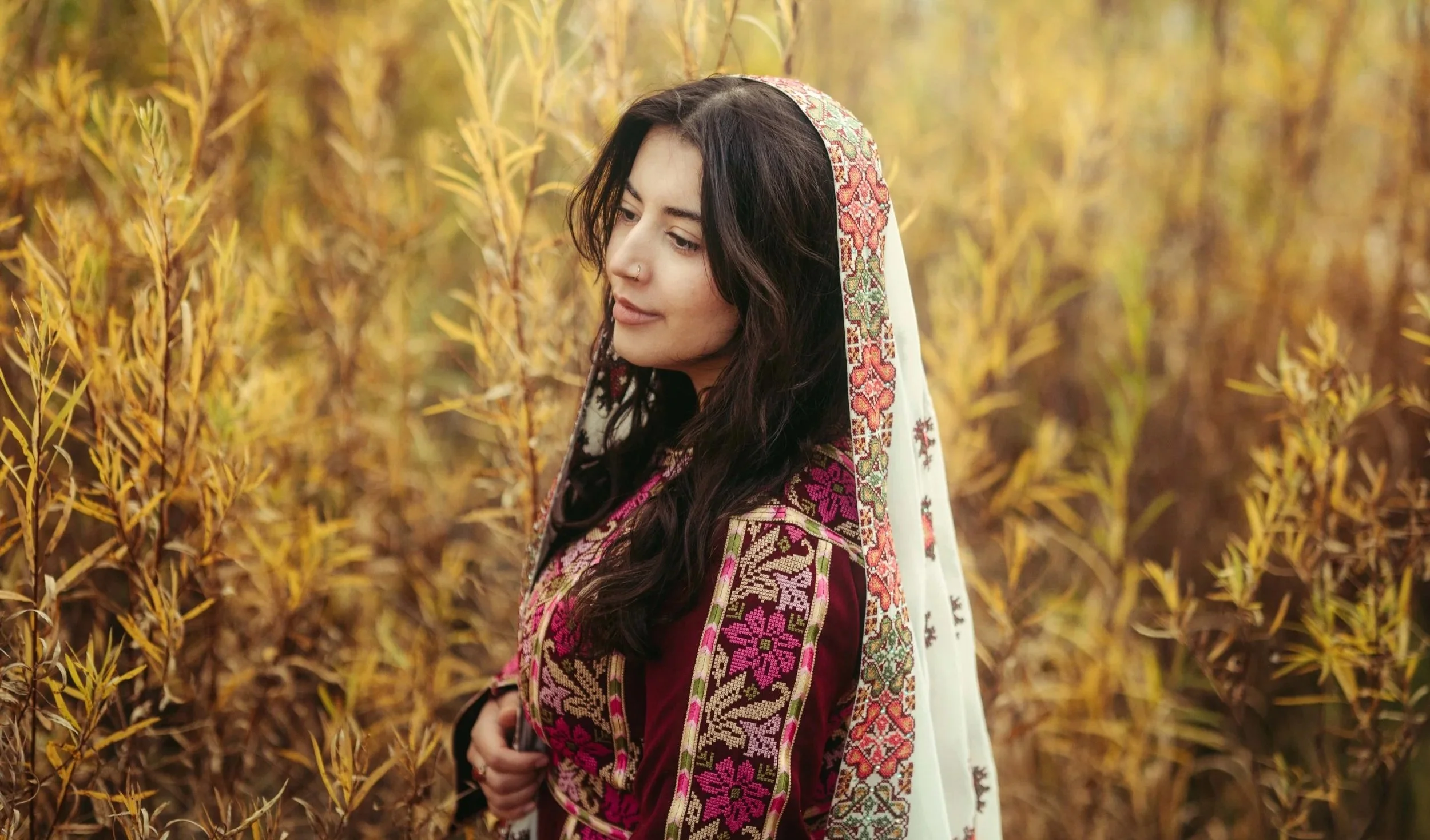
Sara lingers at the hem of her story.
Holding her words close to her heart, aware of the distance between this moment and everything waiting back home.
She traces it back to the people who first anchored her sense of home and belonging; back to Bethlehem, where her grandparents married, and to Al‑Malha near Jerusalem, where her grandfather was born.
“My grandparents got married in Bethlehem,” she begins.
“After my oldest uncle was born, my grandpa had the option to work in Kuwait,” she says. “That’s where my mother was born.”
At the beginning of the Gulf War, Sara’s grandmother left Kuwait and headed to Jordan with Sara’s mother and uncle, leaving Sara’s grandfather and five aunts behind.
Sara’s father’s story unfolded differently.
He was born in a village in Palestine named Qaneer. When he was young he was displaced to Fa’ara refugee camp, where he grew up until exile was inescapable, ultimately thrusting him across the border into Jordan too.
So it was in Jordan that her parents met - through family connections - and married.
America entered their story through one of Sara’s uncles who went first for his masters, and eventually helped bring her father along with him. Her father went first.
Her mother’s journey to join him in the U.S. hinged on the seal of approval on her papers, tucked among hundreds of manila folders in government offices.
In the stretch of waiting, Sara was born in Jordan.
Two years later, the stamp of approval finally marked her mother’s papers, unlocking the path to join Sara’s father in the long-awaited promise of America.
—
Growing up in the US, it didn’t take long for Sara to recognize that she was stitched from a different cloth.
At home, Sara’s parents only spoke Arabic.
Outside, the world spoke only English; a language completely foreign to her.
Sara entered kindergarten carrying only what her mother could pack into her hands: the alphabet, a few numbers, the soft certainty of Arabic at home. In the classroom, everything sounded like it was happening too fast. She remembers the first day not as a blur, but as a sharp memory.
Her mother had packed her lunchbox. No one told them kindergarten was only half a day. The teacher welcomed Sara with a screech: " ‘We don’t have lunch here!’ ”
Sara didn’t yet have the English to defend herself. She only had the heat of being watched as she was scolded. Her small body suddenly on display, the class staring while she tried to understand what she’d done wrong. Later, she switched into a different kindergarten class, but the feeling stayed: the sense of being out of place before she even knew what being in place meant.
Still, she found a foothold. A friend named Zed who was also from Jordan, and who spoke English better than she did. She clung to that friendship like her translation. But even that was contested. Other kids wouldn’t let her play with him. Otherness, she learned, wasn’t just an internal sense of feeling out of place. It was enforced.
“It was really hard growing up,” she says, and the memory still presses against her voice.
—
In Sara’s childhood living room, news on the television wasn’t background noise, it was a ritual. It constantly broadcast conflict without rest: “Lunch, dinner, everything.” The Second Intifada. Iraq. Afghanistan.
The faces flickering across the screen were not strangers; they were part of the same region her parents came from. Images of bombings, soldiers, funerals, and protests filled the room. The violence wasn’t isolated to one place. It traveled across the Arab world in waves.
And it was understood in her house that the channel should never be changed.
“Lunch, dinner, everything,” she says. “If my dad was sleeping and we changed his channel, he lost his mind.”
It was a kind of devotion; her parents’ insistence on staying connected to the places that raised them, and the places still being wounded. They stayed connected to what was happening, even if it hurt, because being unseen was a worse kind of violence.
At school, she heard the same events described differently:
“They were just repeating whatever their parents said.”
Sanitized. Scripted. Propagandized.
“I was angry from a young age,” Sara recalls. “Because people thought they were right, but they didn’t know.”
She had context that was absent in her classroom. She understood that these were not isolated incidents, but part of a longer story, one her own family had lived through. So when her classmates spoke with certainty it enraged her, because she knew the frame was incomplete.
—
Living in the US, Sara grappled with the contradictions of identity.
“I’m Palestinian. I can survive anywhere.”
She continues, “They can throw me in the middle of the street in a random country, and somehow I’m going to figure it out.” But survival wasn’t just practical. It was also about identity and belonging.
At school, she went from navigating English as a newcomer to being hyper-aware of the assumptions others made about her nationality.
“People never understand how you can be connected to a land you’ve never lived in. How do you explain that to someone?”
Being a Palestinian in this world felt like a constant tug on her identity.
“You come to America and people say, ‘Where you’re from is where you’re born.’” she says. “But I’m not Jordanian. I’m Palestinian. It made me so mad...like they were trying to erase my heritage.”
When you ask Sara what home means, she pauses then lets out a soft, almost apologetic laugh, like she’s reaching for a simple answer she can place in your hands, and all she can find is the ache of it.
“As Palestinians we never know where home is.”
Then her voice changes as she recalls one time home that felt undeniably hers: the first time she visited Palestine.
Something inside her recognized the land instantly.
She felt her ancestry in every step.
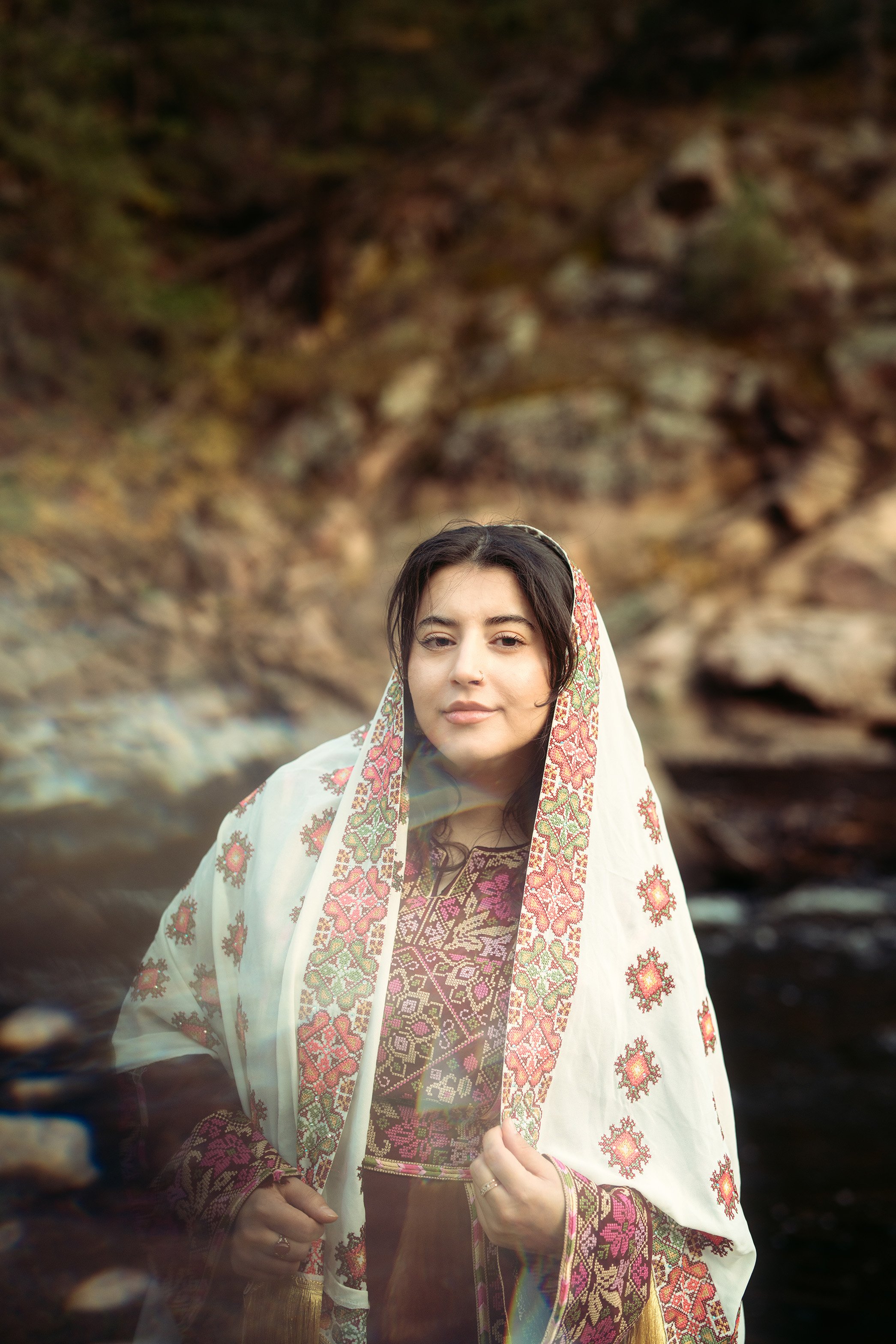
“The only place that felt like home was the one time I went to Palestine.”
She continues, “I was like, oh my God, I feel like I belong here.” It wasn’t logic. She explains it as an aura. The feeling of standing in a place her body recognized before her mind could explain it.
“Just knowing this is where your ancestors were for so many years.” she says “It doesn’t make sense, how people can just come and take that all away.”
Home, for Sara, is intricate and layered. Woven across generations, home is a patchwork of closeness and chaos shaped by displacement and resilience.
While the physical sense of home is unfamiliar for Palestinians in the diaspora, Sara finds her sense of home in the moments she’s with her family.
She remembers going back to Jordan in 2009 when her grandfather was still alive. And every Friday, her grandparents' house filled, one-by-one, with aunts and uncles and cousins who made the rooms feel too small yet somehow exactly right.
“My grandparents feel like home. They brought everyone together.”
Those Fridays at her grandparents’ house left an imprint that continues to reverberate deeply within her. “They sacrificed everything. I know my grandma regrets leaving, but she left to give her kids a better life.”
Then she talks about her grandfather the way people talk about someone who defined decency. “My grandpa...he was humble,” she says. “He was such a good man.”
She remembers her grandfather's acts of kindness and presence in how he cared for his family with tenderness and didn’t abandon what needed him.
Sara tells us about how during the Gulf War when her grandmother, mother and uncle left Kuwait first. Her grandfather stayed behind with five of Sara’s aunts. The youngest, born with Down Syndrome, was still a baby then. Her grandfather stayed to take care of her and ensure she led a life of dignity.
For Sara’s grandfather, showing up for family wasn’t a principle. It was simply how he lived.
—
Being Palestinian, Sara grew up carrying the reverberations of her parents’ and grandparents’ exile, through every Friday visit, and every family meal. But belonging remains elusive for Sara.
“I don’t want to belong anywhere, sometimes,” she admits. “And I’ve accepted that you don’t have to belong anywhere.”
That absence of rootedness to a physical place was part of what makes her connection to Palestine so profound. Her connection to the soil that held and witnessed generations of her family’s livelihood, resilience, and reverence.
When Sara talks about Palestinian culture she beams, as if she is finally naming something that gives instead of takes.
She loves weddings, but she cherishes Henna parties where she gets to wear the culture, literally. In cloth, song, and movement in a room full of women turning history into celebration.
“I love everything about Hennas," she says. “We get to wear our cultural clothes. We get to sing our cultural songs, dance our cultural ways.”
And the embroidery.
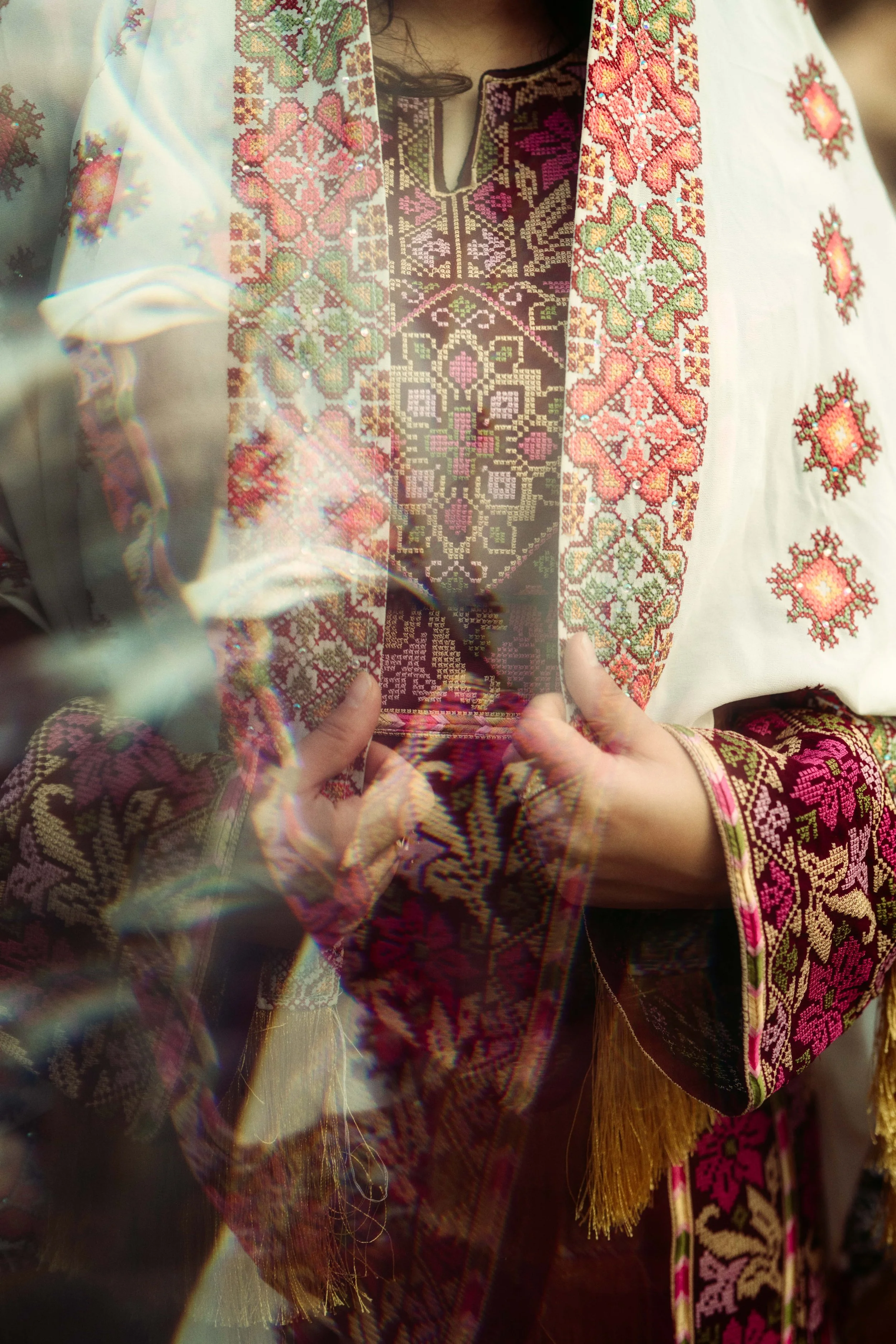
She treasures Falahi embroidery- the traditional Palestinian stitching born from rural villages, carried forward like a record you can wear.
“There’s so much history behind it,” she says, “specifically to Falahi Palestinians.”
Falahi refers to the rural farming villages of Palestine. Communities in these villages are deeply rooted to the land, especially in the olive trees.
The embroidery born from those villages is not random decoration. Each region has its own patterns and stitchwork marked with geography, livelihood, lineage.
Falahi women recorded their villages in thread long before maps were re-drawn by western cartographers.
So to wear Falahi embroidery is to wear your land on your body. These native stitches are a crucial link to Sara’s ancestry that defies displacement.
In a world that tries to reduce Palestinians to headlines, Sara’s threads insist on a different kind of proof: lived continuity.