
Complexity Made Visible
Written by Joie Ha based on an interview between Malek Asfeer and dena harry saleh
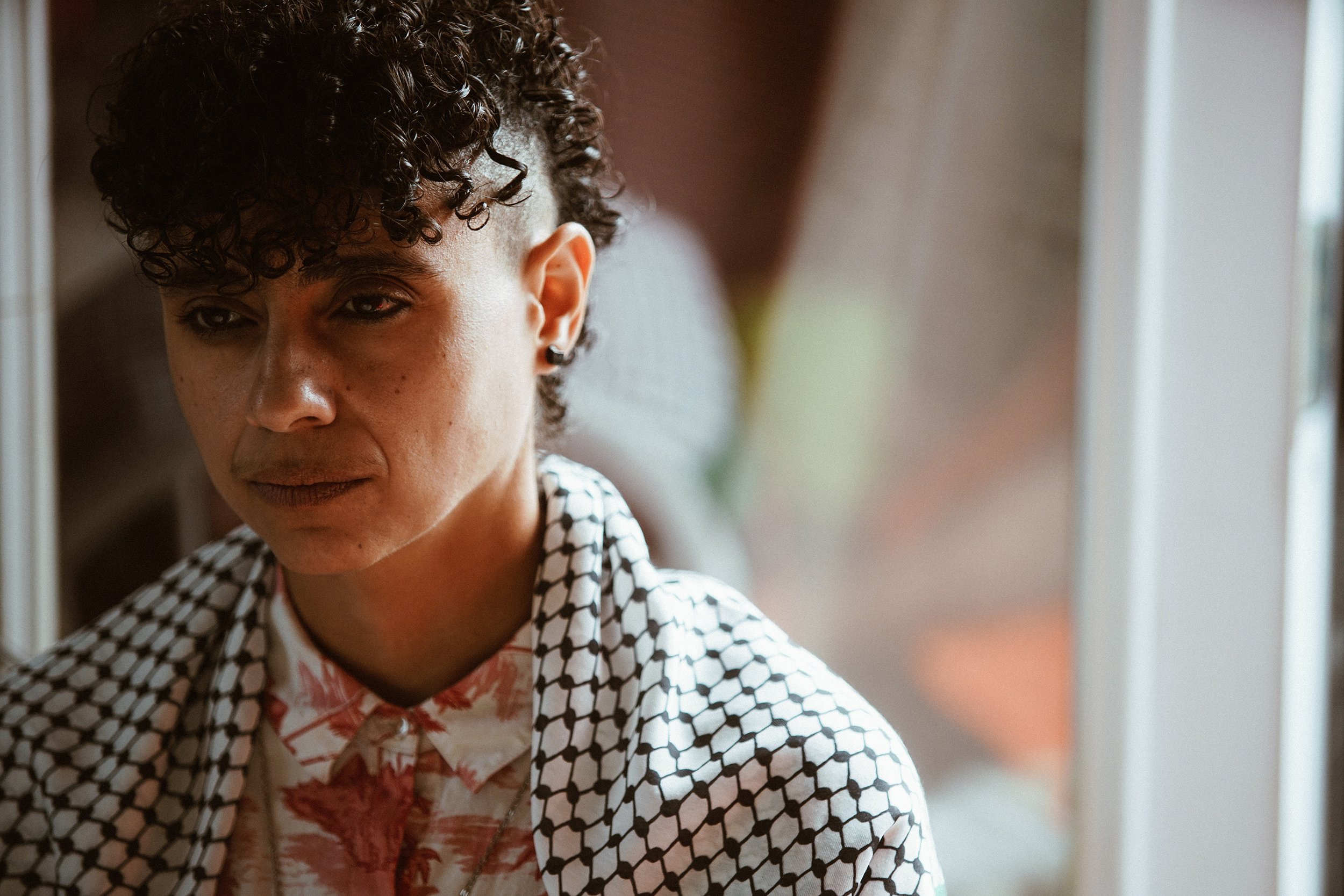
At 10-years-old, dena’s first memories of Palestine were the winding roads, a land that felt both tropical and desert, and a sea that cradled the shore. The world opened, as endless as the meandering streets and as deep as the ocean reflecting the generosity of its stewards. It felt like being free.
Born in Denver, dena- who goes by they/them pronouns- was welcomed by a countless myriad of aunts, uncles, and cousins. For nearly three weeks, they spent much of their time playing outside with the boys. Three days before the end of the trip, their mom told them it was unseemly. The other women had criticized her for allowing her girls to play in the streets. dena spent the rest of the trip indoors in stifling boredom, closed off from the expansive new life they were exploring.
This was one of dena’s first encounters of how their growing queerness was something others wanted to tame and contain- a first fracture between gender and belonging. Like how the surrounding land and its people were being forced into submission by the occupation, dena’s gender was being nudged into what was socially appropriate. The homeland and the body- both bounded by imaginary borders built on violence and shame.
Regardless, dena reflects on the visit with fondness, as a reconnection to their lineage and its intertwining with their queerness. The memory remains one that ties dena to their generational past, and projects into the future. No matter what, Palestine is home. dena shares, “I have a deep longing to return…to live there and to die there. InshaAllah.”
—
Growing up, dena had to navigate the tensions of their identities and all that came along with them,
“being Queer and Falesteeni in Denver, it was like, no one else was.”
As a Palestinian, their family settled in the very land that facilitated their displacement. In a way, this de-politicized them. Aware of what it meant to be too different in a new country, dena’s family assimilated for safety and did their best to be normal. But despite their efforts, simply being Palestinian was already seen as deviant.
In high school, one of dena’s best friends shared that their grandparents had survived the Holocaust. Thinking that they could relate, dena shared the story of their family’s expulsion from Palestine. The conversation happened at a coffee shop, an opportunity for deeper connection. But their friend had been unable to see their similarities, insisting Palestinians were at fault for their exile. dena shut down, their body present but mind elsewhere. A cold realization crystallizing, built up from many smaller instances before this- even to those closest to you, being Palestinian meant that you will always be dangerous and foreign, a stranger to be regarded with suspicion.
Their nascent transness was treated no differently. They had to discover and come to terms with their queerness at a time and place that was deeply ignorant at its best, and violent at its worst. Even by the ones who loved them most, it was something seen as aberrant and unnatural, even threatening. Their body and their lineage- an exile in exile.
—
In search of new horizons and to find those more like them, they moved to New York. There, they began to understand more of who they were and found belonging with other radical Palestinians during the second intifada. They went to college, made art and music, and started going to demonstrations. It was there that they built the political consciousness of what it meant to be free.
dena speaks fondly about their friend, Hasan Hourani, a Palestinian painter in New York who became part of their newfound community. Hasan often painted himself in different landscapes, something that he said was apolitical, but dena saw as revolutionary in a time where Palestinians were pushed into the margins of invisibility. It was with Hasan and other friends like him that helped dena learn how art and music could serve as a point of connection, reflection, and resistance- a way to build and amplify an unignorable Palestinian movement.
—
A decade later, dena returned to Denver. They brought what they learned from New York and continued to work towards Palestinian liberation. The work was slow, but they remained committed. When the genocide picked-up with fervor after October 7, dena was in the midst of a 365-day challenge of creating art and poetry. Before, some of dena’s pieces were about their Palestinian identity. Afterwards, it was in nearly every iteration,
“Almost every single piece I made was about the genocide or about Falasteen, or about my dad or my mom or my family.”
The images of the atrocities committed in Gaza were numerous and unavoidable, broadcasted in gruesome detail all over social media. dena’s art spoke to this, but also to the resilience, strength, and power of the people of Palestine. When asked how they were feeling, dena replies, “Of course I have a lot of rage. I have a lot of deep, deep sadness… so then committing myself to this practice of creation…is a beautiful thing.” It’s a whirlwind of emotions- how could a human truly comprehend the scale of suffering in ways we were never able to witness before?
Amidst all of the death, dena chooses to create. Since 2023, dena has since released a poetry anthology, A Free Palestine, started a PhD to research the Palestinian diaspora, and has helped raise over $90,000 to support mutual aid and direct services to displaced Palestinians in Gaza and Cairo.
—
Recently, dena’s 83-year-old father was in the hospital for a heart attack. It’s his seventh one. He survived the Nakba when he was 5, stopped his education during the 8th grade, and has worked ever since. Unable to return to his village, dena’s father spent time in other areas of Palestine and Germany before moving to Denver in the 70s. He is deeply familiar with the hard edges needed to endure a world insistent on his erasure.
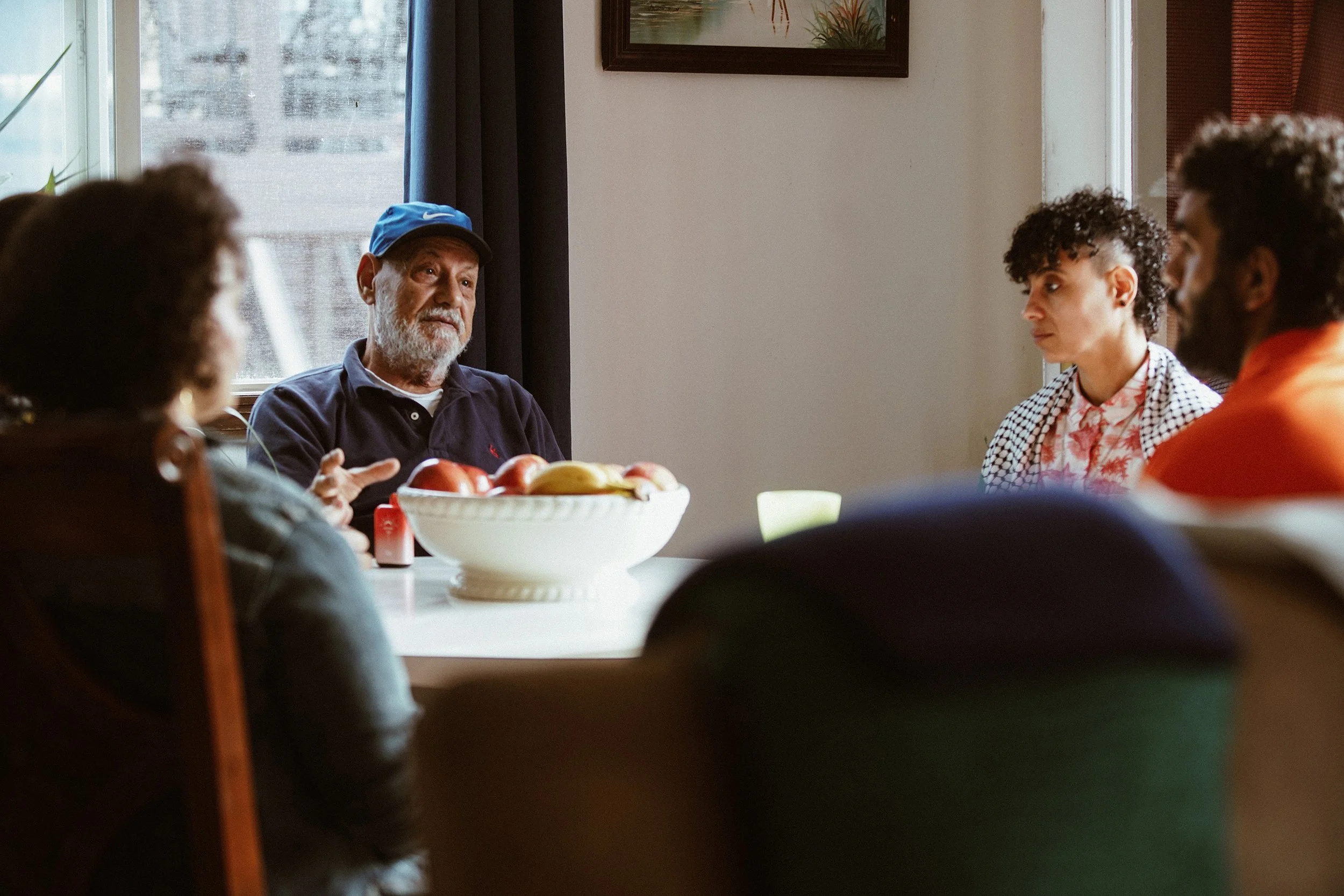
dena’s parents met all of their material needs, but the trauma from the violence they experienced remained a spectre throughout childhood. There is no doubt that their parents loved them, but much tenderness was like the luggage left behind during the Nakba- not necessary for survival.
As a parent themself, dena grapples with the heaviness of their childhood and the mortality of their father- something that has become increasingly clear with his repeated visits to the ICU. “It's hard to share the nuance of how I grew up. I don't want outsiders to demonize my family or pathologize them. At the same time they were not the best in terms of being loving supportive parents,” dena contemplates.
With an ever-polarizing world and the narrow stereotypes that Palestinians are forced into- either victim or villain- dena wonders, “how do we talk about childhood abuse and neglect and trauma in Palestinian Muslim households without making it about the colonially constructed deficit of Palestinian people?” For dena, there needs to be space for these complicated questions, but sharing them is always a risk- what if others use it against them?
Trauma doesn’t end with one person. It spills out- unmitigated and messy. Like an unsolicited inheritance, it passes down to future generations. For a people that have been constantly forced to survive for decades, the job of healing is pushed off to their descendants. It is an unfair task, but dena pursues the tension in the nuance so that their children can grow with tender love. So one day they can step foot with unburdened hearts into a free Palestine.
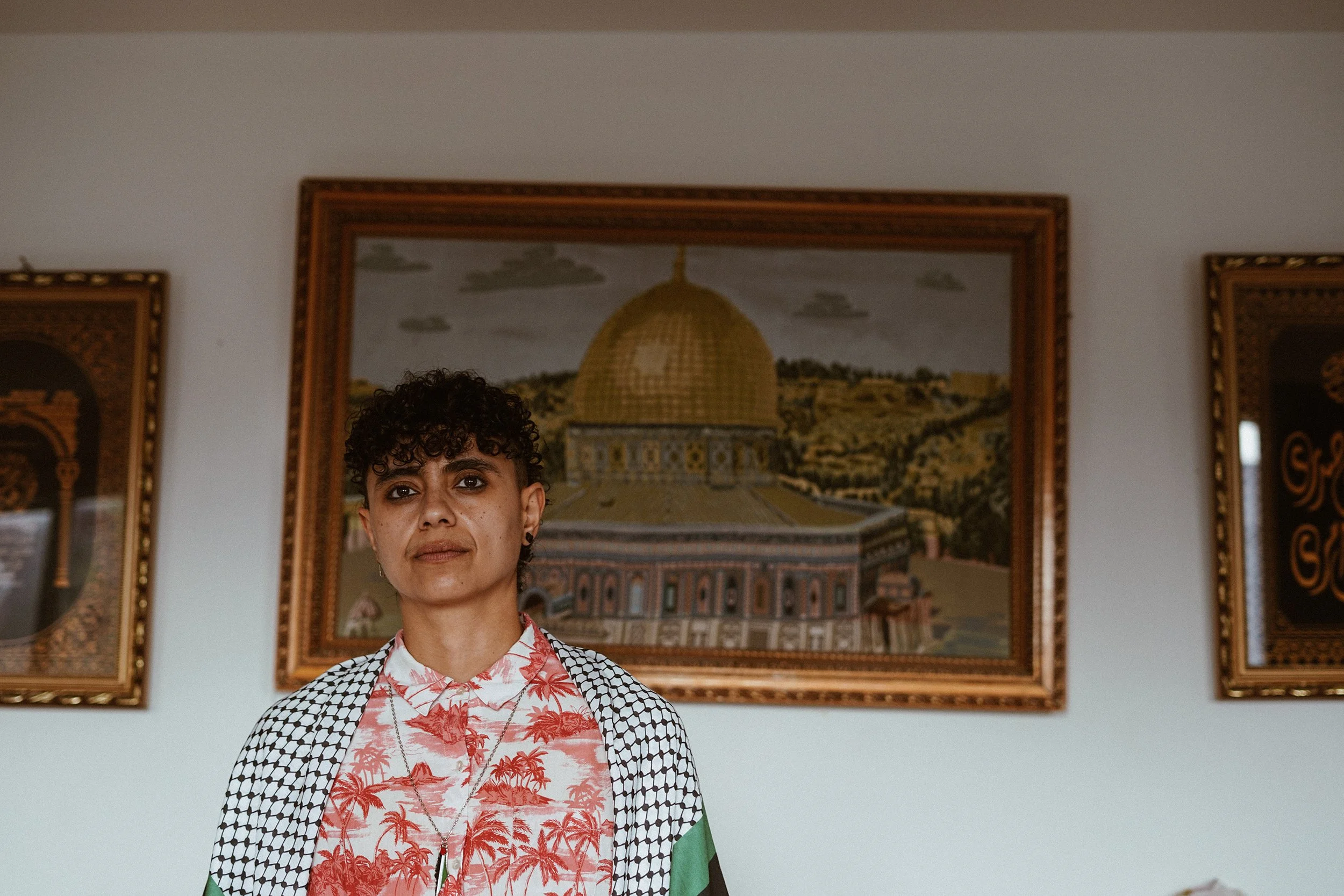
“I am queer, I am trans, I am Muslim, I am Falasteeni. All the identities that this regime hates, you know, all of them, and that's pretty great.”
dena’s life has often been one of finding meaning between their intersecting identities. Some may seem like contradictions, but dena disagrees.
As a Muslim, dena has had moments in their life where they questioned their faith. At times people have insisted to them that because they are queer, ‘you must hate Islam because Islam hates you.’ Regardless of how others may perceive their spirituality, dena shares “I always have felt held by Allah… [my identities] are not mutually exclusive. My queerness and transness and Muslim faith…they are all part of me.”
Society has often put Palestinians in a mold, where their identities are flattened and complexity is made invisible. For dena, “there's no box, you know, it's just me.”