
Elsewhere Within
Written by Malek Asfeer based on an interview between Malek Asfeer and Rimah Alami
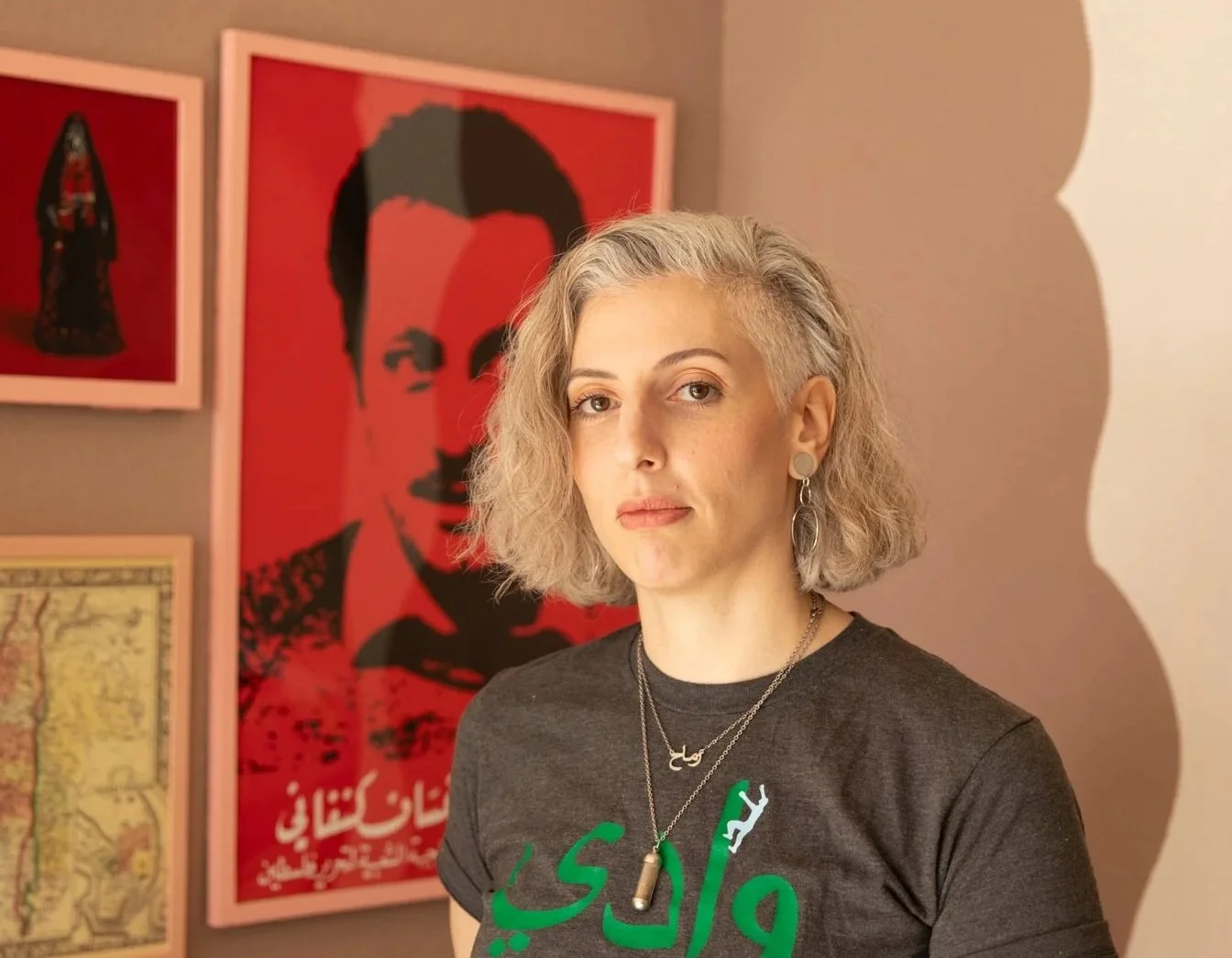
Rimah Alami grew up in California speaking Arabic.
That is how the world first arrived for her. Through a language that moved differently across the tongue than the English spoken around her classrooms. When she entered school, she remembers how the shift was immediate. The words she used were not the words her classmates knew. The lunches she carried from home did not resemble the ones laid out on other desks. Her name, too, stood apart. It carried the essence of a place her teachers could not pronounce, and her classmates could not locate on a map.
Difference introduced itself early.
The story of how she came to carry that difference begins long before California.
Both of Rimah’s parents are Palestinian. Her father was born in Gaza. Her mother was born in Kuwait. They eventually met in the United States, carrying fragments of a homeland shaped by distance, rupture, and inheritance. Their histories arrived in Rimah’s childhood through the few stories that remained impossible to bury.
One of those stories has lived inside her family for decades.
Her grandparents, on her mother’s side, fled their home during the Nakba. In the chaos of that escape, while moving from one uncertain place to another, they lost a child. A three-year-old daughter died while the family was fleeing.
The memory sits in Rimah’s mind without embellishment, clipped almost in a way to discourage more conversation. A story too difficult to recall with any specificity. It appears the way many inherited histories do, sudden and heavy, a fragment carried forward through generations who were not present for the moment itself but must live with its echo. She holds the heaviness, even though she does not know the shape of it.
Her parents rarely spoke about the past in detail. Silence, she suggests, was not absence but a form of protection.
“Because of the generational trauma,” she says, “they didn’t talk about it a lot.”
Yet the inheritance of Palestine did not only come as grief. It also shone through the community.
When Rimah was young, her parents were active in gatherings with other Palestinian families. They attended events, open mic nights, and cultural celebrations. In one memory that her father still tells, the children at one gathering learned a traditional folk song and performed it for the adults.
Rimah insisted on being part of it.
She doesn’t remember the song, but she remembers the feeling of it, the way that the words flowed from her mouth, the way her chest filled with pride.
Her father later joked that those moments revealed something essential about who she would become. Even as a small child, she was confident in her voice and what she had to say.
“I’d always want to go up,” she says. “He knew I was going to be outspoken.”
But the United States has always had a way of reshaping the identities it receives. For Rimah, that reshaping accelerated after September 11.
The months that followed that day altered the atmosphere around Arab and Muslim communities across the country. Suspicion moved through public life. The language of terrorism attached itself to entire populations. The effect was not limited to news broadcasts or political speeches. It seeped into the quiet decisions families made in grocery stores, classrooms, and public sidewalks.
Rimah remembers feeling the shift even as a child.
There were moments when her mother spoke Arabic outside and Rimah felt a sudden anxiety rise in her chest. The language that once felt natural now seemed to draw unwanted attention. Without fully understanding why, she began to distance herself from parts of her identity.
“I didn’t want people to hear,” she says. “I was worried about what would happen.”
The result was not a complete disappearance of her Palestinian identity, but a fracture.
“There was kind of a break between my roots and my culture after that.”
Years would pass before that fracture began to heal. The process did not come through a single realization, but through a gradual recognition that survival did not require erasure.
“If someone judges me,” she says now, “I’m still going to be okay as a person.”
That understanding came with time, and with the quiet labor of reclaiming a self she once felt pressured to hide. Yet the tension of living between worlds never fully disappeared.
Rimah describes herself as a “third culture kid,” someone shaped by multiple cultural environments but belonging fully to none of them.
The phrase captures something that has long been difficult for her to explain.
“I feel like I’m too American to really belong in Palestinian spaces,” she says. “And too Palestinian to belong in American spaces.”
The result is not simply cultural confusion. It is a persistent awareness of standing slightly outside whatever room she enters.
That awareness followed her into adulthood.
In professional settings, she often chooses caution when conversations drift toward politics or the Middle East. The risk is not always explicit. It exists in the subtle possibility that speaking openly might reshape how colleagues see her, or how employers judge her.
There was a job where she stopped being careful. Where she answered honestly when colleagues asked about her name, her family, where she was from. She told them she was Palestinian. She told them what that meant to her.
What followed was the kind of backlash that is nearly impossible to prove and extremely easy to dismiss. Not the kind you could point to cleanly that would survive an investigation. Just a stark shift in the atmosphere. She felt it. It was the sort of change that’s easy to experience and hard to document.
When she talked about it with her colleagues - who were white Americans - the response was reflexive.
‘I don't see that happening. That's not happening to you.’
This denial landed differently than the blacklash itself. The backlash was hostile. The denial was blatant erasure. It came from people she worked alongside every day, people who had smiled at her and eaten lunch near her and asked how her weekend was. They looked at her experience and told her it wasn't there.
She went to HR. HR investigated. HR concluded nothing had occurred.
So she left the job.
"I just don't want to experience that again," she says now. And so she has learned to read rooms before she speaks in them. To calculate. To decide, each time, whether openness is worth what it might cost.
Experiences like that have taught her to move carefully.
“I’m very protective about it,” she says.
That protection extends to the emotional labor of explaining Palestine to people who ask. Over the years she has encountered many who approach the topic with curiosity but little commitment to understanding its depth.
When strangers ask her to explain the “conflict,” she rarely attempts to summarize it herself.
Instead, she offers something else. Books. Articles. And resources.
“If they want to learn, they can go read,” she says. “I’m not going to do all that emotional labor.”
Even among people she trusted, the ground could give way without warning.
In November of 2025, a conversation started in a group chat among close friends. The movie that came up was Team America: World Police – a puppet film from the creators of South Park, built around a joke that Arabs speak in nothing but noise. The film's Arabic was a single repeated phrase: derka derka. That was the whole bit. A joke built on reducing Arabic to nonsense.
Her friends were laughing about it. Quoting it. She sat back and watched the messages flood her phone.
Derka derka.
She knew these people. They knew her. For years she had been open with them about Palestine, about what it meant to her, about the work she did. She had built a TikTok account, with around fifteen thousand followers, devoted entirely to Palestinian history and literature and stories. These friends followed that account. They had watched what she made. They knew exactly who she was.
She waited to see what they would do with that knowledge.
Derka derka.
Eventually she spoke up. She told them it was offensive. One friend apologized immediately, and said she hadn't meant anything by it. But the others said nothing. The conversation simply moved on.
What stayed with her wasn't the movie. It wasn't even the quoting. It was the silence of the friends who said nothing. She knew that in their own lives, they needed constant reassurance that they were good. That they had done right. They asked for that reassurance regularly, from her and from others. They were people who cared, loudly and often, about being seen as people who cared.
And they had nothing to say to her.
"These are people that knew me," she says. "They knew how important this was to me."
She stopped talking to them. Not dramatically. She just stopped. There was an emptiness where affection once made its home.
Yet alongside those moments of rupture, there are also moments of unexpected solidarity.
One of Rimah’s closest friends today is a nurse she met through rock climbing. Years ago, Rimah invited her to watch a documentary called “Resistance Climbing” about Palestinian climbers in the West Bank. The film followed athletes navigating checkpoints, occupation, and limited access to resources while still pursuing their passion for the sport.
Her friend left the theater deeply moved.
Since then, she has continued learning about Palestine on her own, speaking about it with others and offering support in ways Rimah never anticipated.
Those moments matter. They remind Rimah that understanding is possible, even if it arrives slowly.
Still, when she reflects on what it means to live as a Palestinian in the United States, one word returns again and again.
Resilience.
“You have to be resilient,” she says. “Especially growing up in places where there wasn’t a lot of diversity.”
As a child, the desire to belong can feel overwhelming. Friendships matter. Acceptance matters.
Learning to exist outside that acceptance requires a strength most children are never asked to develop.
With time, that strength became something else.
A foundation.
Today Rimah is in Colorado where she works full time while completing graduate school to become a nurse practitioner.
Her commitment to education carries a meaning that reaches beyond professional ambition.
For Palestinians, she says, education holds a particular kind of security.
“People can take your home. They can take your land. They can take your belongings. But no one can take your education from you.”
If there is something she hopes future generations will inherit, it is that sense of permanence. Alongside it, she hopes they carry forward the culture that has endured despite decades of attempts to erase it.
Art. Poetry. Literature. Music.
She laughs when recalling something a friend once told her; “She said every Palestinian she meets is a poet.”
Palestinians have long lived within histories shaped by exile and rupture. Yet within that history, they continue to produce language that refuses disappearance. Poetry becomes a way to hold memory when geography cannot.
For Rimah, one of the writers who captures this tradition most powerfully is Ghassan Kanafani. His stories, particularly Men in the Sun, explore the quiet despair and endurance of displaced Palestinians seeking survival beyond their homeland.
The characters in those stories are not heroes in the traditional sense. They are ordinary people navigating impossible circumstances, moving through landscapes where help arrives too late or not at all.
What Rimah remembers most is the book's foreword. Kanafani tells a story about a father who overhears the moment his child learns, for the first time, that he is Palestinian. The father watches it happen. He watches his child absorb it. The understanding that this identity - before the child has done anything at all with it - means that much of the world will hate him.
The father witnesses how his child is forever changed. How innocence warps to fit reality, how the burden of being Palestinian is carried before any school backpack.
Rimah recognized something in that scene. Not because she had lived the same life as Kanafani’s characters. She had not crossed deserts. She had not stood at checkpoints. But the knowledge arrived anyway.
It arrived in school hallways where her language sounded unfamiliar.
It arrived in the quiet fear that followed her mother’s Arabic in public.
It arrived in the long work of learning how to carry a name that pointed somewhere else.