
Mud Child
Written by Rand Shannak based on an interview between Malek Asfeer and Meera Alul
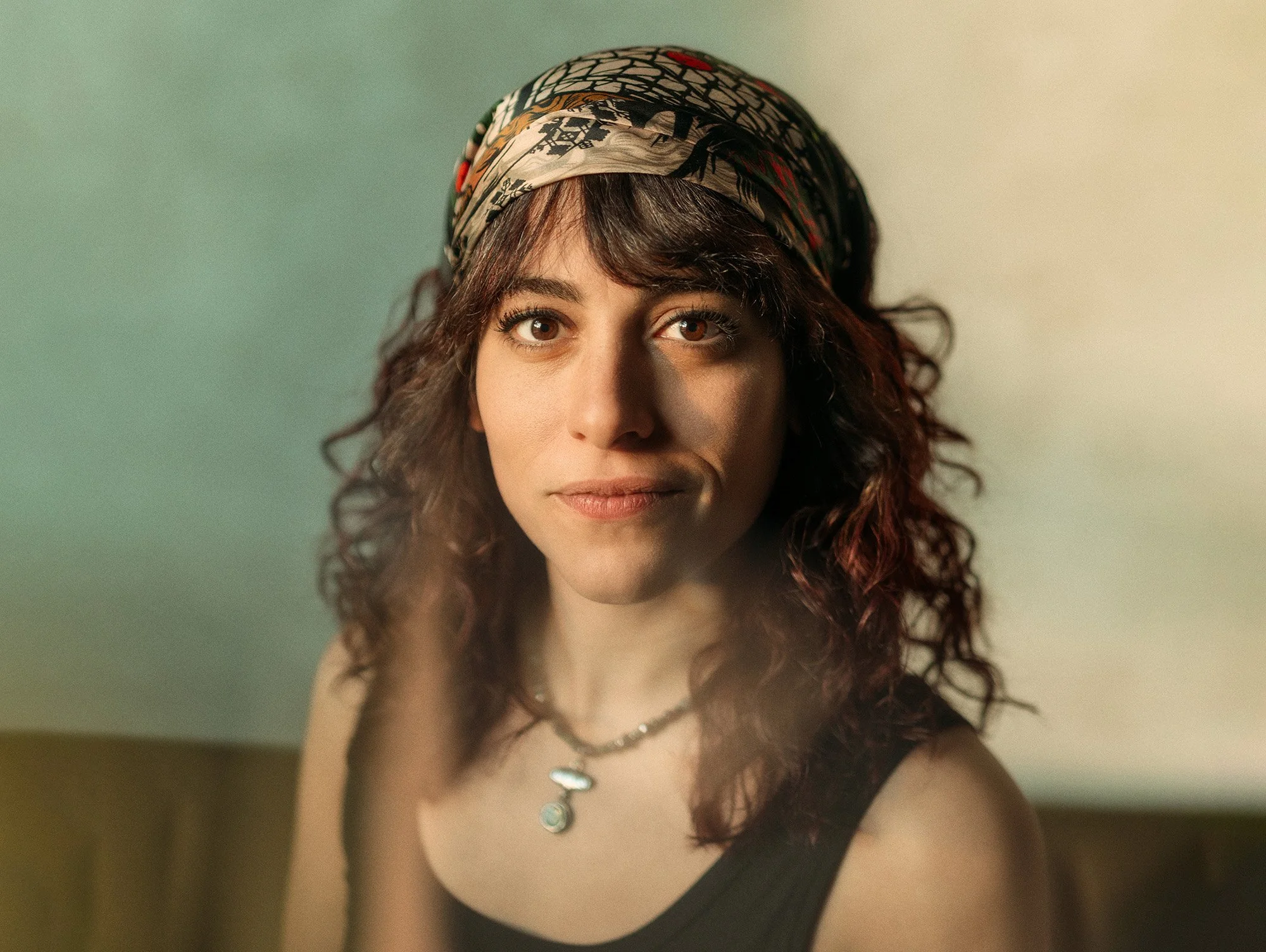
Meera’s Palestinian identity no longer enters the room quietly.
It arrives the way Athan - the call to prayer - carries over the rolling hills of Nablus. Unapologetic. Uncontained. Impossible to ignore.
Her voice permeates Denver’s streets through mics and megaphones. Her volume isn’t spectacle. It is inheritance. It carries grief without trembling. Love without apology. Struggle without flinching.
Meera’s Palestinian heritage no longer folds into careful explanations.
It flows freely in the cadence of her Arabic slipping out before she can think to translate it back. In the certainty of her stance. In her refusal to shrink.
For Meera, being Palestinian shows up whole. But that wasn't always the case.
“In college I’d say I was Arab. I wouldn’t say Palestinian,” she says. “And if they asked me to elaborate, I would maybe bring it up, but in a very defensive way.”
Growing up, safety translated into omission. So she edited herself. Measured the air before speaking. Braced herself for defense. But from the start, something in her never settled into that quiet.
—
Meera was born in New York and raised in Sharjah, UAE. She spent most summers in Nablus.
Suspended between polished towers and her grandmother’s stone house layered with generations, she lived between passports that opened doors and borders that closed them.
But Meera inherited displacement long before she was born.
Her mother’s family is from Jaffa Salama, a town dissolved on modern maps. It survives more in memory than geography.
Her grandparents met in Gaza, where they built a life in exile. Her grandfather, a respected lawyer, was jailed for refusing to collaborate with the occupation. In his refusal to surrender, his homeland’s occupiers made breathing impossible.
Carrying what could not be confiscated - his dignity, memory and refusal - he escaped to Kuwait.
Meera’s mother followed soon after. It would be the first of many border crossings in a life shaped by diaspora.
Kuwait was temporary. A waiting room of exile. A suspension between what had been severed and what had yet to take root.
Exile carried her across the Gulf to Sharjah, a city rising from desert and sea. Sharjah offered steadier footing. Not return, but recalibration.
Years later, across an ocean she had never imagined crossing, Iowa offered opportunity. Her journey to the Midwest began the quiet opening of an unlikely meeting point for two scattered histories.
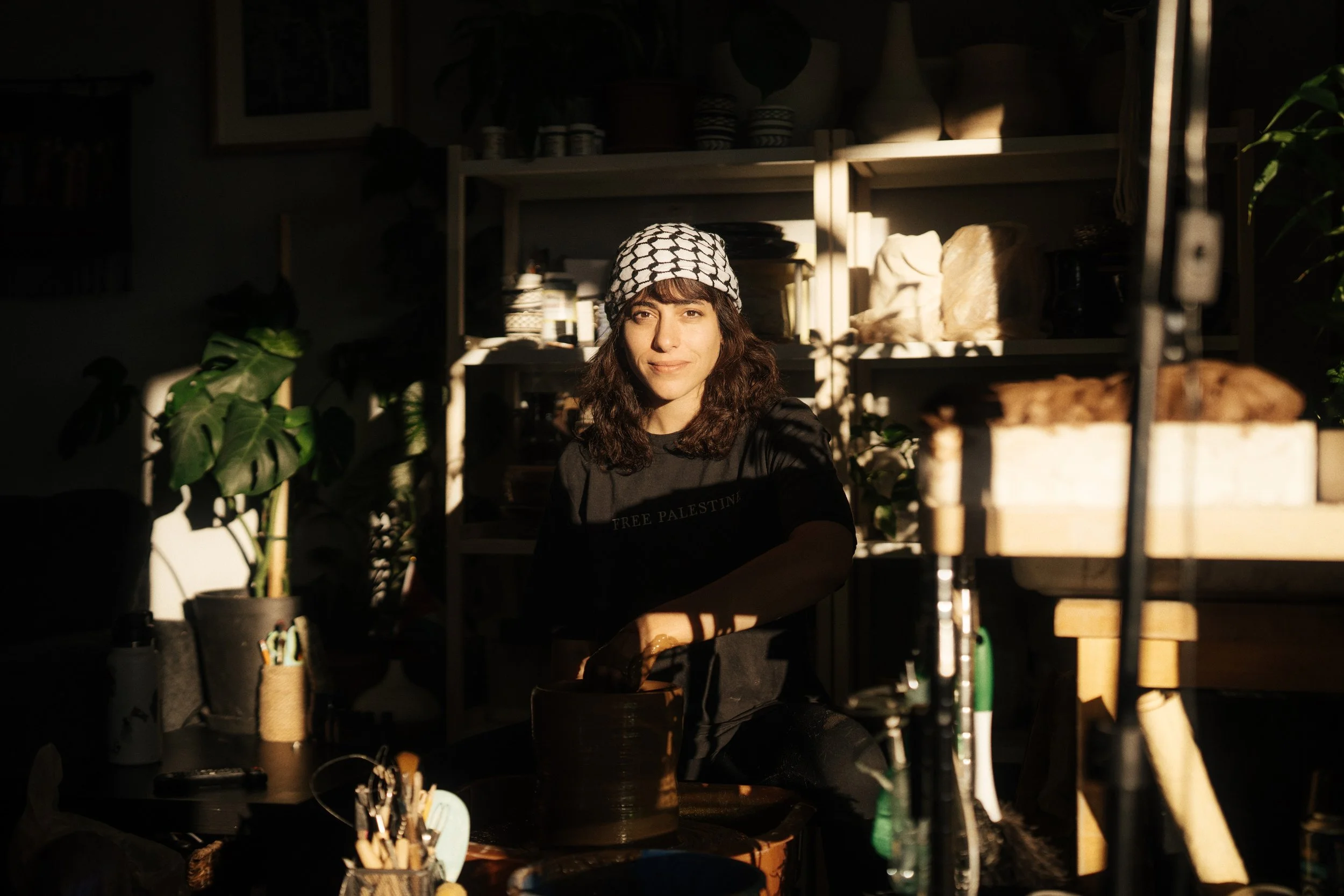
Meera’s father’s story began in Nablus. He was born into the stone house where Meera would later build her own summer memories. As a teenager, he began drawing the attention of soldiers. He learned the cost of resistance early, as many Palestinian boys do. His exile began in a boarding school in the UK, distance disguised as protection.
A few years later, that distance widened. He crossed another ocean to the United States for college.
He landed in Iowa, where exile braided itself into love. Into family. Into the beginning of something neither lineage could have anticipated.
Two families rearranged by displacement in the 1960s. Two uprooted lives entwined in the 1990s.
And for the first time, the crossing was shared. They made their way to New York.
Then Meera was born.
—
When you ask Meera about Nablus, her voice slows, becoming fuller as she recalls her grandmother’s house.
“That house is my favorite thing,” she says. “You can just walk out and you get into Old Town Nablus.”
It is not the architecture. It is the continuity. To walk through the rooms in the stories of her father’s childhood.
“Visualizing all of that while he's telling us the stories was one of my favorite things,” she shares, “And just walking through the house and seeing all the memories that my grandma had, like the room that my dad was born in.”
The house in Nablus feels sacred. It holds her lineage. Her history. It holds everything except permanence.
“I don’t feel like I have a specific home.”
Each memory shared of her summers in Nablus is interlaced with the shadow of siege.
Each memory shared of her childhood is fragmented by the disconnect of being a Palestinian-American living in the Gulf.
“Disconnect was a constant theme in my life,” she says. “I have frighteningly few memories of my childhood, and in hindsight, we call that dissociation.”
Dissociation. The word hangs heavier than she intends to.
Dissociation is not forgetfulness. It is survival.
It is what happens when your body learns to split comfort from catastrophe. When siege and safety share the same timeline. When military tanks barrel through the living room of your childhood memories.
“I think I’ve had an identity crisis my whole life,” she says. “We were living so nice and safe in the UAE. Then we would go to Nablus for the summer. We’re at my cousin's engagement party and suddenly we’re stuck because there’s tanks rolling around outside.”
Growing up Palestinian in the UAE meant watching Al Jazeera while doing homework. It meant knowing that your family’s comfort was not universal. That somewhere else, someone with your name was being searched at a checkpoint. It meant learning how to hold contradiction without collapsing.
She lived well. Her family built a stable life. They worked hard for it. Alhamdulillah - praise be to God - they would say. A word Palestinians carry like breath. Gratitude spoken when the ground beneath their homeland shakes. But gratitude felt incomplete when it existed beside occupation.
“I don’t know how to shut my eyes and say alhamdulillah for everything I have when everyone else is going through all of that stuff,” she says. “...And just because I'm okay in this moment, it doesn't mean that all of that stuff is gone.”
Raised in exile without ever having left, she navigates the meaning of belonging beyond the physical. “Belonging,” she says, “should really boil down to a connection, an empathy and an understanding between our beings, between our souls that kind of transcends the places that we come from. The people that we meet, the things that we've experienced.”
After completing her grad school dissertation on Palestinian Art, Meera moved back to Denver in early 2020.
She answered a call to protest against an escalation in Jenin. There, for the first time, she saw a room full of people saying Palestine out loud without whispering.
And in that moment everything shifted.
“Once I saw that, that was when I started to get more involved. And that was really when I started to be way more open about who I was as a Palestinian, regardless of whether or not people were going to understand,” she says.
“I’m not going to hide behind making others comfortable over being who I am anymore.”
And since that door opened, Meera no longer enters the room quietly.
Today she’s on the streets organizing. Educating. Fighting city councils and university boards and strangers on sidewalks who think history can be debated like a sports score.
But the politics of survival can swallow you whole. And grief takes up oxygen.
“All of my parts are surviving right now,” she says,
Yet even in the midst of struggle, she carries joy in the way Palestinians celebrate even under siege. Zaffas that shake the walls. Grandmothers’ ululating. Laughter that refuses to quiet itself.
“I love how loud and celebratory we are,” she says, “That laughter and music and joyous celebration that accompanies every event is incredible to me.”
—
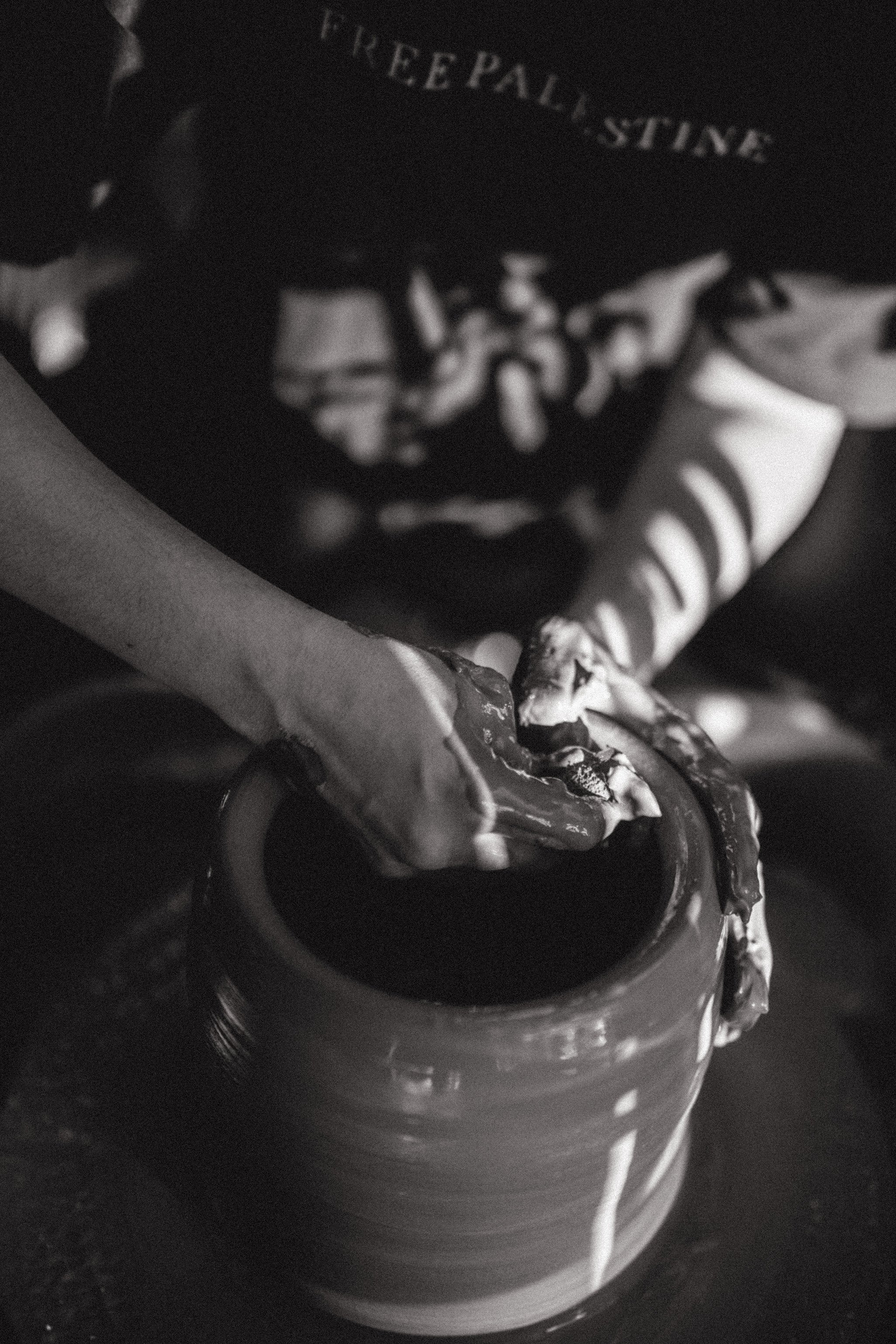
In her art, Meera reaches for something softer.
“I just want to be a mud child. I want to be in the clay, in the charcoal, in the paint, in the chaos.”
A child of sediment and smudge.
Dirt beneath her fingernails.
Not polished. Not curated.
A mud child does not perform resilience. She does not explain herself into belonging. She sinks her hands into the soil without asking whether she deserves it.
To be a mud child is to belong to the land without argument.
It is the opposite of dissociation.
It is presence.
For Meera, being a mud child is a return. To tactility, to material, to something that cannot be debated away. Clay remembers the hands that shape it. It does not demand justification.
Where survival fractures, art gathers.
Art is not escape.
It is translation.
“Art can be such a powerful tool for communication. For humanizing the other.”
She carries Palestine not as a slogan, but as a frequency. Something that hums in her body whether she wills it or not.
For Meera, being Palestinian “means to exist in a state of connection with the earth and all of her beings, regardless of the constant attempts by every other being on this earth to disconnect us from [it]. It means to be resilient and to love regardless and to laugh and sing and celebrate and not forget the struggle that we're in.”