
The Fortress
Written by Rand Shannak based on an interview between Malek Asfeer and Maya Otoum
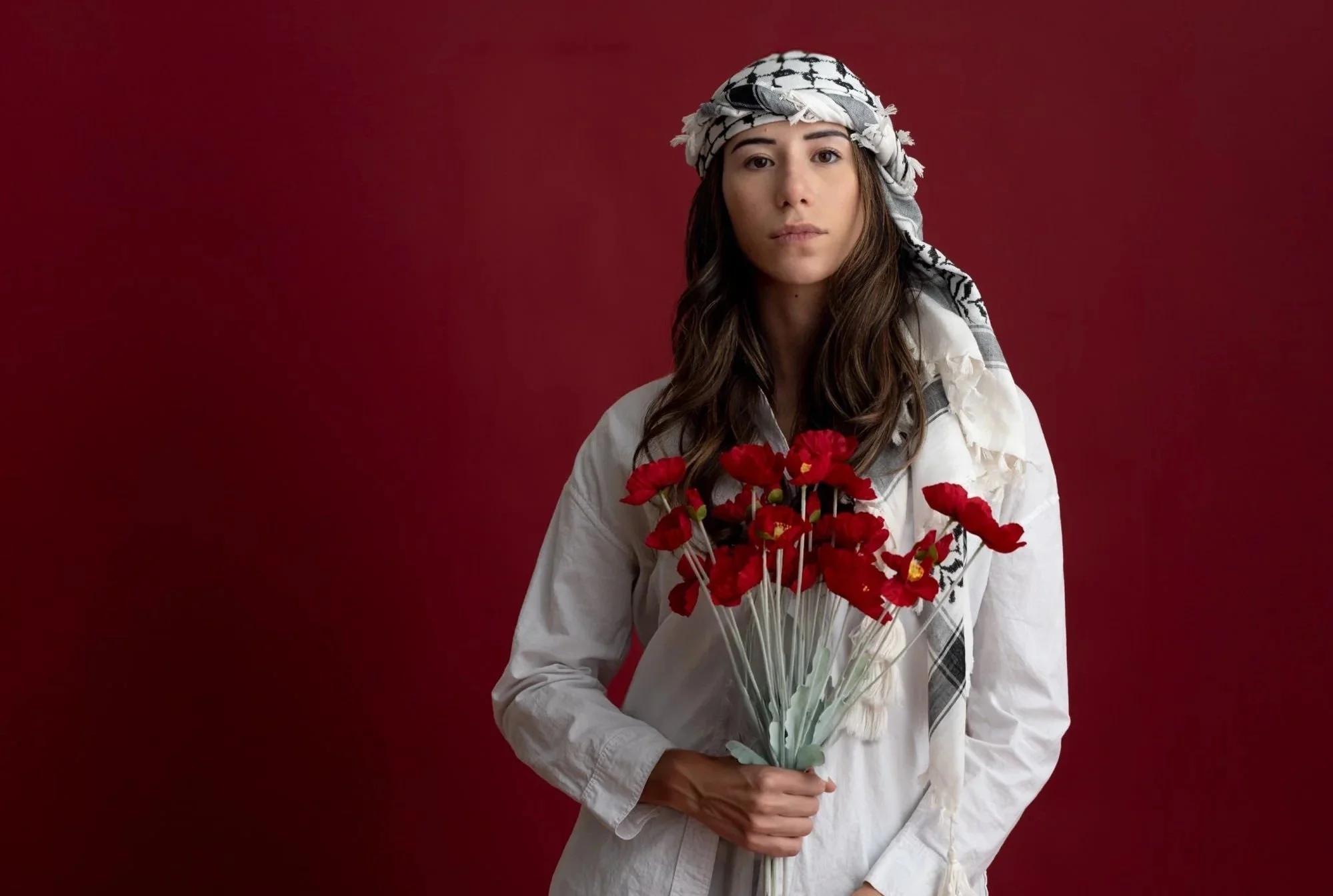
Before there were passports and green cards, and before there were PhDs and master’s degrees, there was a Palestinian widow who raised nine children in exile.
Her journey began in 1967, and it was the first of two crossings from Jenin, Palestine to Amman, Jordan that would forge the foundation of Maya’s story.
That year, both sides of Maya’s grandparents crossed the Jordan River, their every step haunted by the Naksa that swept through their land.
Naksa is the Arabic word for “setback,” referring to the sudden and violent massacre and uprooting of Palestinian villages. Within just a few days, the Israeli occupational forces surged into the West Bank, East Jerusalem, and Gaza, leaving carnage, destruction and exile in their wake.
Villages shuddered from the thunder of bombardment.
The air thickened with the smoke of houses being bulldozed to rubble.
Streets dusted with debris of scattered generational remnants.
Parents clasped their children and whatever they could salvage before the roar of military tanks reached them.
Maya’s maternal grandparents crossed the river first. Her grandfather, having enlisted in the Jordanian army, secured the path to refuge in Jordan sooner. They thought the move would be temporary.
It wasn’t.
“Both sets of grandparents essentially left their home behind,” she says. “And their land, which they haven’t been able to return to since.”
Her paternal grandparents crossed later that same year; their journey was harsher. They fled on foot, hiding from the occupation that hunted them while carrying a toddler on their backs. That toddler was Maya’s father.
When they arrived in Jordan, they moved in with family friends from Jenin: Maya’s maternal grandparents.
There was one thing neither grandparent could carry with them on their journey. One thing no arms could hold and no bag could contain: Home.
Not just the physical sense of the word, but the certainty of what that word would mean for the generations that followed.
Yet in this life of exile, something else began to take form.
A fortress that would shape Maya’s life began to rise before she was born. Built not of brick or stone, but from the discipline of her mothers and the steady labor of her fathers, who met exile’s instability and adversity not with collapse, but with endurance and resolve.
—
As Maya’s grandparents settled more firmly into Jordan, her mother was born.
Shortly after Maya’s mother’s birth, her grandfather died, leaving her grandmother to raise nine children alone. While his Jordanian military service secured government stipends to help, they couldn’t ease the grief or the unrelenting burden of raising so many children. One day, her late husband's brother offered to help by marrying her or taking her children.
“She was like, ‘Get the f*** out of my house.’”
Maya beams as she tells the story. You can feel the respect. The legacy.
“She was kind of a badass,” she says.
Her grandmother's response paved the way for the rebuilding, the insistence, and the creation of a life that would not be reduced to pity.
Meanwhile, Maya’s father’s upbringing was defined by movement. His family moved back and forth between Jordan and Kuwait, navigating uncertainty and opportunity.
Bound by this determination, endurance, and adaptability, Maya’s parents were raised knowing resilience as a daily practice. Eventually, these childhood friends grew up, married, and had their first child in Jordan: Maya’s older sister.
—
While pregnant with Maya, her parents traveled to California to visit family. Maya was born there. They returned to Jordan for two years, until a rising demand for pharmacists beckoned them to make a more permanent move to the United States.
With his pharmacy experience, and Maya’s U.S. passport paving the way, her father applied for his own passport, and the family relocated to California in search of opportunity.
But life in the U.S. was far from easy.
Her father went from pharmacist to selling insurance, before slowly working his way back to pharmacy again. A recalibration familiar to many immigrants: qualified on paper but reduced in practice; forced to begin again in a foreign country who read his identity and credentials with suspicion. He worked long hours and faced overt racism.
“People were incredibly cruel to him,” Maya says.
As her father navigated the Western job market, her mother raised their daughters in a country whose language she didn’t yet speak. Make no mistake - she was anything but a standard homemaker. Like her own mother before her, she was relentless and brilliant, bending this new and foreign world to her will while building a life from scratch.
“My mom has a PhD,” Maya says, her voice full of reverence.
She remembers sitting quietly in the back row of her mother’s graduate classes as a child, watching her mother take on dense textbooks and complex lectures with a calm ferocity. Every page, every exam, every long night of study was another brick in the fortress she was building for her family.
“All that was to provide a life for us,” Maya says. “It’s such a life of privilege that came from so much difficulty.”
While her parents built stability brick by brick with each long hour worked and lecture attended, Maya was in elementary school, quickly realizing that her world wasn’t quite the same as the one around her.
She distinctly remembers a family presentation day at school. Her mom dressed her in a traditional Palestinian thobe, fabric heavy and embroidered, and sent her with zaatar, olive oil, and bread to share with the class.
“I talked about Palestine,” she says.
The classroom went quiet. Eyes stared back at her blank and uncomprehending.
Standing there with her culture worn on her body and carried in her hands, she felt utterly alienated in every detail. The smell of zaatar, the weight of the thobe, the bread pressed into her small palms, all reminded her that her world didn’t fit into theirs.
—
When Maya was ten, they moved to Dubai.
Surrounded by Arabs from across the region, she thought the distinction would blur, but it only sharpened. She noticed how others could visit their homeland with ease. She’d visit Jordan because that is where her family lived, but Jordan wasn’t her homeland.
“I never actually got to go to Palestine,” she says. “So why were we always talking about Palestine, but we never been to Palestine?”
As a child, she felt almost cheated by this invisible tether. Why couldn't she touch, see, or walk the streets of the place that was so central to her identity?
Her parents answered cautiously, explaining the occupation, the danger, the displacement, and the loss. And gradually Maya began to feel the weight she carried just by being Palestinian.
It was from this tension that her understanding of belonging began to take shape.
“Belonging means acceptance to your every core of who you are.”
Diaspora complicates that. You are caught between worlds. So you spend your life piecing together something, something in-between, that feels like home.
Maya describes movement as woven into the DNA of Palestinians in the diaspora. When your original home is no longer an option, constant relocation can feel natural. Almost instinctual. But it comes with a lingering loss.
“I don’t feel really attached to any place I’ve ever lived,” she says. “I don’t really call any place my home.”
Even today, as a homeowner, she feels distance from permanence. “We live here, we bought it. I don’t feel particularly attached to it. I always assume we’re going to move out one day.”
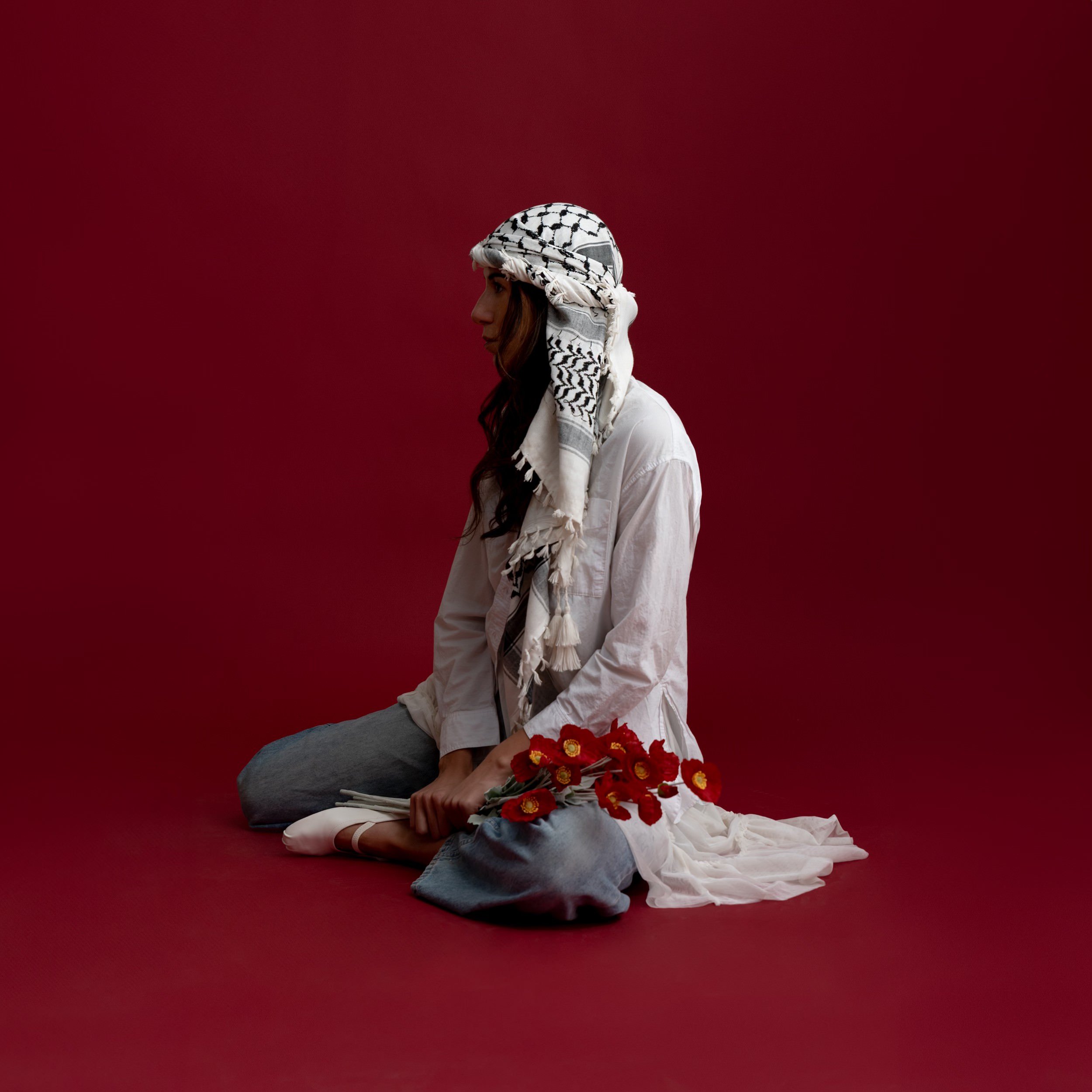
So what does home mean to Maya?
“Home doesn’t really feel like a physical location,” Maya says. “Home always felt like where people I love are.”
At her core, she says, “I am Palestinian,” because she doesn’t fully feel American or Jordanian or Emirati. Her identity is clarified in her heritage.
When asked what part of Palestinian heritage most resonates with her, she doesn’t hesitate.
“Food is our biggest love language,” she says. “I feel most like I’m honoring my culture and my ancestors and myself when I’m sharing food”
Cooking preserves tradition. Sharing carries it on. For Maya, that is what always reminds her of where she belongs.
—
In college, Maya moved back to the United States to pursue her degree in engineering.
By then, the cruelty her parents had endured had changed shape. Her father faced it directly with overt racism and suspicion. Maya encountered something more discreet, but no less corrosive: a widespread ignorance about Palestine.
As classmates and co-workers described Israel as “a nice place to visit”, she felt pressure to smile and nod, knowing that if she spoke up about where she was from, the conversations always escalated.
“I spent a lot of time being just really angry,” she says.
She was angry at erasure. Angry at stereotypes. Angry at the tension between enjoying American freedoms and defending an identity that was constantly villainized, exoticized and misunderstood.
Over time, her anger changed form.
“I’m the only person I have any form of control over,” she says. Focusing on what she can control became her lifeline.
“Being Palestinian,” she says, “means a lot of pride.” She jokes about how Palestinians sound aggressive when naming where they are from. Saying ‘I’m Palestinian’ carries more force than introduction, because it’s spoken against erasure.
“But honestly, for most of my life being Palestinian has felt like survivor’s guilt.”
She describes the constant, gnawing battle Palestinians in the diaspora carry. The endless push and pull through grief, loss, and absence:
“It could be worse. It is worse back home,” she says, with audible weight in her voice. “Every Palestinian carries some form of survivor’s guilt. You feel powerless,” she says. “Sometimes, you don’t know how to keep going, but you just keep going anyway.”
Pride and guilt coexist. Tangled like roots and thorns growing from the same wound.
—
Then October 7 happened.
Maya was in California and it was the day of her katb kitab, an intimate Islamic ceremony that marks the beginning of a marriage.
That morning when she woke to the news, she anticipated the haunting undertone of what was to follow.
After her ceremony, she opened social media and saw posts confirming her anticipations. Posts of blanket condemnations that erased context.
“I’m seeing people I work with, people I went to school with posting stories with ‘Pray for Israel. Hamas is disgusting.’”
She remembers thinking, “ You don’t understand the full story…you should look into what the boiling point was.”
Her anger rose again like smoke after a fire she thought had burned out.
But this time it was sharpened by something worse: watching the suffering of her people flattened into headlines and content.
“Every day I’m seeing photos, videos, children that look like me just blown to bits,” she says.
“I’m coming home and crying every single day.”
She recounts the early days of watching the genocide unfold through the glow of her screen. Swallowing between sentences, as if forcing the words down before they can break her. Each memory laced with heavy, unshakable survivor’s guilt.
Scrolling through the sterile glare of her iPhone, she bore witness to a dissonant loop of unrelenting reels.
Lifeless infants cradled in the arms of sorrowing mothers.
skin-care tutorial. get ready with me!
Toddlers who looked like her cousins, ribs like ladder rungs beneath a leaking tarp.
meal-kit ad. thirty min to joy. plate. garnish. bon-a-petite!
Children who looked like her nieces, powdered gray as they’re pulled from the rubble..
vacay promo. couples laughing on turquoise water. two-for-one flights.
Swipe. Howls from blazing tents swallowed by autoplay.
Swipe. !Flash sale! Ends at midnight.
Swipe. Swipe. Swipe.
She bore witness through a blinding static of swipes all while sitting safely in the belly of the beast. Housed, fed and alive inside the very country bankrolling the bombs that tore through her homeland. Calling it policy.
To survive like that felt unbearable. Almost disloyal. The helplessness felt even worse.
So she went outside.
She stepped into the streets where grief had bodies and voices. Where grief could be mobilized into action. Where anger could be carried through her lungs, instead of sitting like a stone in her chest.
Organizing was not a choice so much as Maya's oxygen. It was the only way she knew to stay alive. It gave her a space where grief could be spoken out loud, where her voice no longer had to shrink beneath headlines, comment sections, and feeds.
“Getting involved in organizing probably saved me,” she says. “Sometimes I wonder if our protests are doing anything, but they are healing for sure. Let’s go out and at least collectively grieve together.”
In Maya’s hands, the fortress her family built moved from foundation to declaration.
But Maya doesn’t assume the privilege of speaking of what she cannot fully know. She doesn’t claim the right to speak for what she has not lived. She approaches organizing with measured humility and quiet moral clarity
“I don’t even know if I want Palestine back for me,” she says. “I want it back for the people who never left.”
She questions how valid her opinion is when discussing solutions: “We get really angry in the diaspora,” she says. “Sometimes we can even be really American about it.” From afar, it’s easier to demand absolutes. To chant total liberation without sitting inside the daily negotiation of survival.
From her family who still live there, she hears the truth in its own terms, beyond the slogans chanted on American streets.
“[Palestinians] really do just want to stop being killed. To be able to travel to a hospital and get care for their children. To live.. Not just survive.”
This exposes the exhausting expectation placed on Palestinians:“I think Palestinians feel like they have to be extraordinary for people to understand they shouldn’t be killed,” she says.
For Maya, that’s what home really is.
Not a place, not even a country, but the ability to live without the constant weight of proving your humanity.
A safe life. Shared meals. Children who grow up without fear.
The life her family has always been building, and the life she carries forward.
